
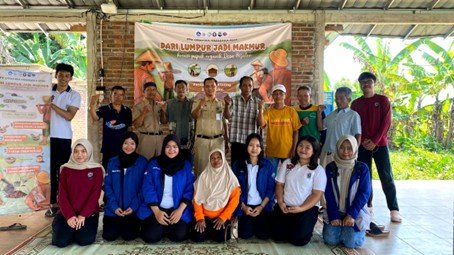
The 2025 implementation team of the Program Penguatan Kapasitas (PPK) Ormawa Himasaka, Faculty of Fisheries and Marine Science, Diponegoro University, organized a training program on processing swamp sediment into organic fertilizer at Pendopo Baru Klinting on August 1, 2025, in Bejalen Village, Ambarawa District. This activity is part of a series of community empowerment programs aimed at increasing the utilization of local resources while supporting sustainable agriculture. The event began with a presentation session on an organic fertilizer formula that had been jointly developed with local farmer groups. The team also explained the potential of swamp sediment, which has long been considered waste, yet contains high levels of organic matter that can greatly benefit soil fertility.
The processing of organic fertilizer as an environmentally friendly alternative is expected to reduce farmers’ dependence on chemical fertilizers, lower greenhouse gas emissions, and maintain soil structure and fertility so that agricultural productivity can continue to increase sustainably. This approach aligns with efforts to mitigate the impacts of climate change and implement green farming practices at the village level. The activity continued with hands-on practice, mixing sediment with additional materials such as rice bran and rice husk charcoal according to the established formula. The implementation team assisted in every step—from sediment sorting, weighing additional materials, and mixing processes, to proper fermentation techniques—ensuring that the resulting fertilizer would be of high quality.
The organic fertilizer produced was then utilized in a crop-planting program after the fertilizer-making process was completed. This planting phase serves as both a trial application and tangible proof of the benefits of swamp sediment fertilizer in improving the productivity of village farmland. Furthermore, the team hopes that the skills gained can be independently applied by local farmer groups, enabling Bejalen Village to develop sustainable organic agriculture that is environmentally friendly and economically valuable.
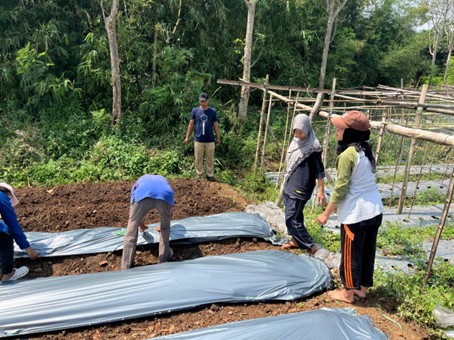
The crop-planting program carried the theme of a “Climate Village” as a solution to food security. The theme adopted was “Resilient Farming for a Sustainable Bejalen”, under the title “Bota-growth.” The activity began on August 4, 2025, with land preparation carried out jointly with the Environmental Awareness Group (POKDARLING), the Farmers Group (POKTAN), and the Village Youth Organization (Karang Taruna). Land clearing was conducted as the initial procedure before planting. Fertilizer application was performed as part of the soil enrichment protocol, functioning as a nutrient source for the plants.
The PPK Ormawa Himasaka team conducted the crop planting seven days after land preparation was completed, on Monday, August 11, 2025. Five types of selected crops—all classified as secondary crops (palawija)—were chosen based on their adaptability and resilience to changes in temperature, humidity, and nutrient-deficient conditions. The crops included cassava, eggplant, peanuts, cucumber, and chili. The planting procedure involved digging soil with a hoe to a vertical depth of 10 cm and a horizontal spacing of 30 cm. Seeds and seedlings were then planted manually by placing them into the holes, covering them properly, and adding fertilizer.
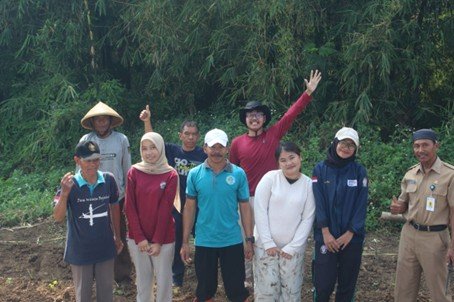
This activity marks a step toward creating a self-reliant village capable of addressing climate change impacts that threaten the quantity and quality of food resources. In addition, the program is expected to serve as a bridge for fostering collaboration and strengthening ties between the PPK Ormawa team and the local community.