
[et_pb_section fb_built=”1″ admin_label=”section” _builder_version=”4.12.0″ custom_padding=”10px||0px||false|false” locked=”off” collapsed=”off” global_colors_info=”{}”][et_pb_row admin_label=”row” _builder_version=”4.12.0″ background_size=”initial” background_position=”top_left” background_repeat=”repeat” custom_padding=”||0px||false|false” global_colors_info=”{}”][et_pb_column type=”4_4″ _builder_version=”3.25″ custom_padding=”|||” global_colors_info=”{}” custom_padding__hover=”|||”][et_pb_text _builder_version=”4.14.2″ text_orientation=”justified” custom_padding=”0px||0px||false|false” global_colors_info=”{}”]
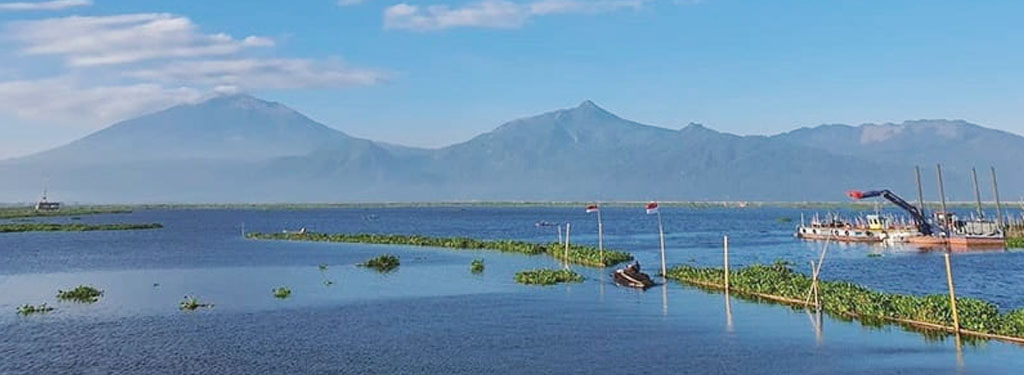
FPIK, SEMARANG – (Source: Suaramerdeka.com) Students of the Faculty of Fisheries and Marine Sciences, University of Diponegoro (FPIK UNDIP) are intensifying research to prevent the risk of extinction of fish species in Freshwater Lake Rawa Pening. The species of Nilem or Lumajang fish (Cycloceilichthys enoplos), Wader Ijo (Osteochilus vittatus) and Wader Bintik Dua (Barbodes binotatus) which are rare species have been detected. “Such fish are called endemic or native fish which exist only in one place and cannot be found in other locations,” said Professor of FPIK UNDIP, Prof. Dr. Agus Hartoko who is the student supervisor.
This research involves tracking biota by Nisrina Septi Haryani, a student of the Aquatic Resources Management Study Program, FPIK UNDIP, guided by lecturers Agus Hartoko and Dr Diah Ayuningrum. The discovery of the species was after applying the research model of morphology, morphometry and genetic diversity with DNA barcodes. “The aim of this research is to find out the endemic species in Rawa Pening, especially wader fish. The method used underlies the morphological analysis, morphometric or meristic techniques and molecular analysis using the DNA Barcoding method. Besides that, it is also through phylogenetic relationships and the level of genetic diversity,” Agus added.
[/et_pb_text][/et_pb_column][/et_pb_row][et_pb_row _builder_version=”4.3.2″ global_colors_info=”{}”][et_pb_column type=”4_4″ _builder_version=”4.3.2″ global_colors_info=”{}”][et_pb_image src=”https://wpsandbox14.undip.ac.id/wp-content/uploads/2021/12/Ikan-di-Rawa-Pening_Dec-2021.jpg” title_text=”Ikan di Rawa Pening_Dec 2021″ align=”center” _builder_version=”4.14.2″ global_colors_info=”{}”][/et_pb_image][et_pb_text _builder_version=”4.14.2″ text_font_size=”12px” text_orientation=”justified” custom_padding=”0px||0px||false|false” locked=”off” global_colors_info=”{}”]
Photo: FPIK UNDIP Student Documentation
[/et_pb_text][/et_pb_column][/et_pb_row][et_pb_row _builder_version=”4.3.2″ global_colors_info=”{}”][et_pb_column type=”4_4″ _builder_version=”4.3.2″ global_colors_info=”{}”][et_pb_text _builder_version=”4.14.2″ text_orientation=”justified” custom_padding=”0px||0px||false|false” hover_enabled=”0″ locked=”off” global_colors_info=”{}” sticky_enabled=”0″]
The research was carried out in March-October 2021. From the analysis of 33 individual fish studied, three endemic fish species were found. The importance of this kind of research is that it brings benefits to the preservation of genetic diversity as well as efforts for captive breeding of endemic fish such as the wader species so that they do not become extinct in Rawa Pening. Without concrete steps, this kind of fish could one day be lost forever. This finding also complements the existence of five species that were first recognized in this place. The original fish that had been recorded in Rawa Pening in a 2006 study were Wader Pari (R. lateristriata), White Wader (R. jacobsoni), Andong Wader (B. canchonius), Cakul Wader (P. binotatus) and Ijo Wader (O .vittatus).
Source: Suara Merdeka
[/et_pb_text][/et_pb_column][/et_pb_row][/et_pb_section]